When a Student Wants to Quit, What Do You Do (or Say)?
When a martial arts student wants to quit, your words decide whether they stay. What to say, the real reasons behind it, and how to win them back.
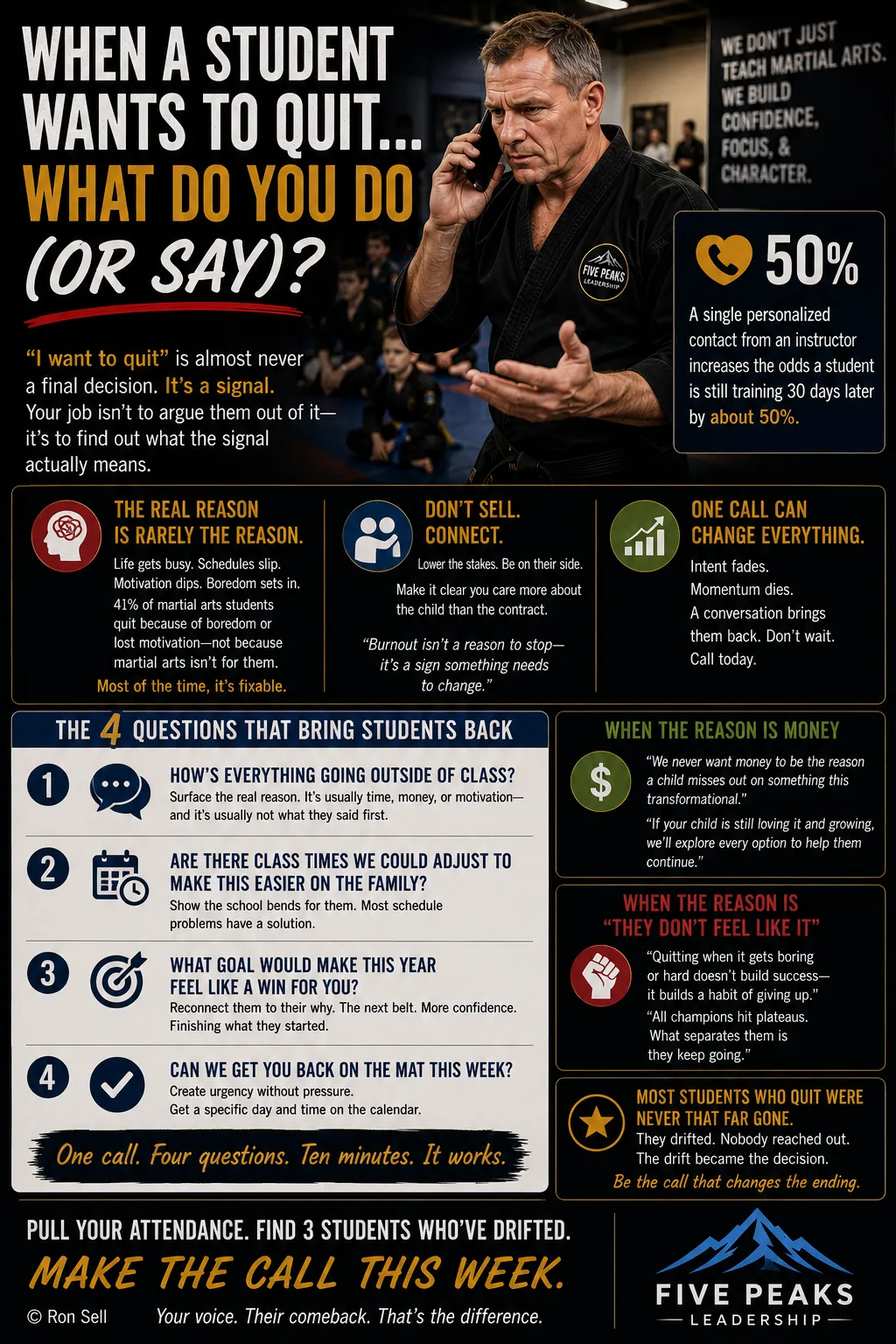
Sooner or later, every school owner gets the message.
Sometimes it is a parent at the front desk, looking a little uncomfortable. Sometimes it is a text on a Sunday night. “Hey, I think we are going to take a break.” Sometimes it is just a student who stops showing up, and you realize three weeks later that they are gone.
And here is what most of us do in that moment. We panic a little. We get defensive. Or we go straight into save-the-sale mode.
Do not.
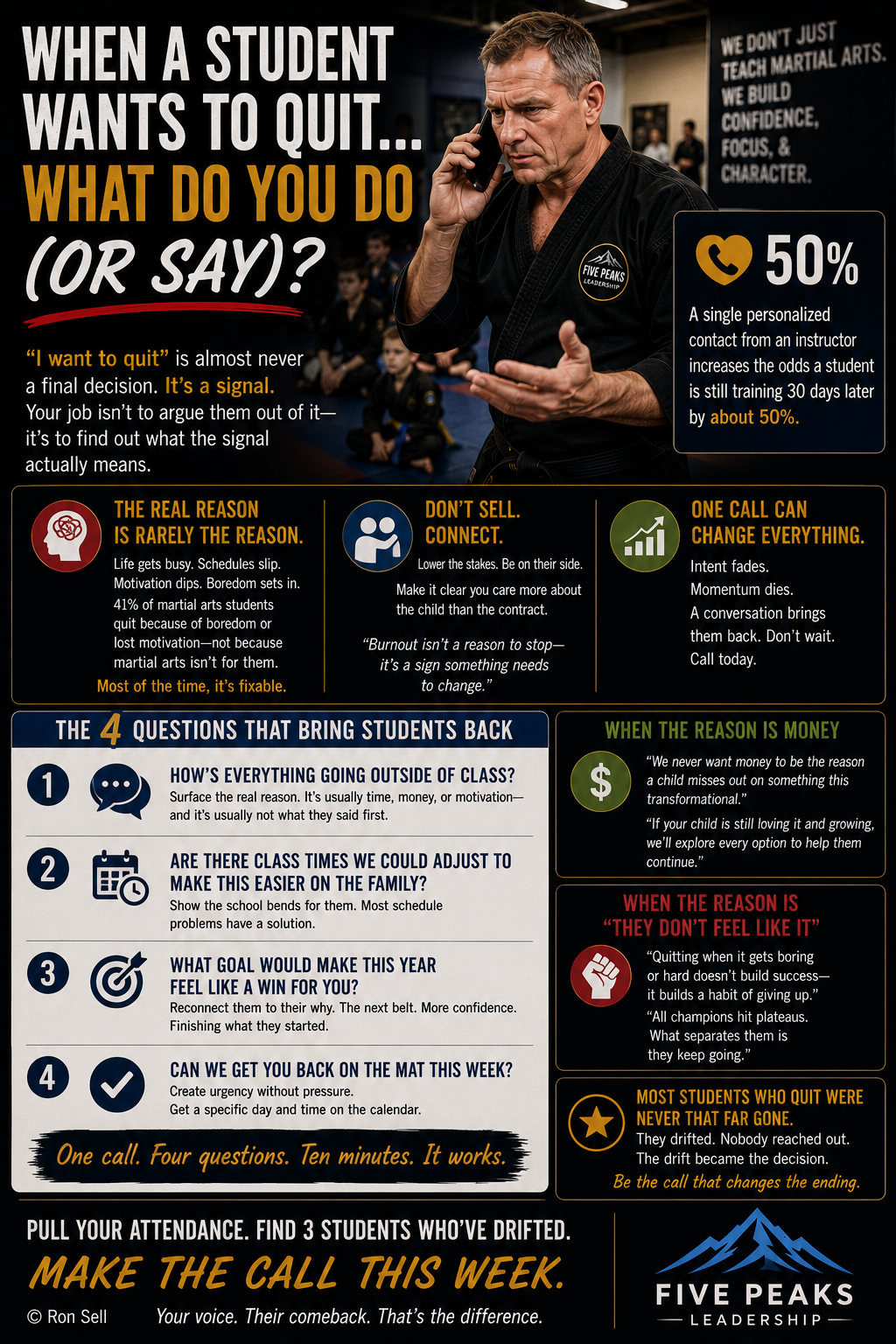
“I want to quit” is almost never a final decision. It is a signal. Your job is not to argue them out of it. Your job is to find out what the signal actually means.
”I Want To Quit” Is Almost Never Final
When a student goes quiet, or a parent says they are done, they have rarely sat down and made a clear, logical decision to leave. What actually happened is smaller and more human.
Life got busy. The schedule slipped for a couple of weeks. Soccer season started. Mom went back to work. The kid hit a plateau and stopped feeling successful.
Roughly 41 percent of martial arts students who quit do so because of boredom or lost motivation. Not because they decided martial arts was not for them.
That is a huge deal. Because boredom and a motivation dip are fixable. A real decision to leave is not. Most of the time, you are dealing with the fixable kind and treating it like the final kind.
So before you say anything persuasive, get curious.
Find The Real Reason Before You Say Anything
Ask one honest question. “How is everything going outside of class?”
Notice we do not go right at the class. We do not say, “Why have you not been in?” We ask about life.
You would be amazed how often the real reason comes out in the first 30 seconds, and it is almost never the reason they led with. Maybe it is money. Maybe it is the schedule. Maybe the kid got nervous about sparring. Maybe it is just a brutally busy season for the family.
You are not prying. You are a coach who noticed they were gone and cared enough to ask. That alone resets the whole relationship.
Do Not Sell. Connect.
Here is the mistake I see most. The second a parent hesitates, the owner reaches for a discount or a guilt trip. Both signal the same thing. You care more about the contract than the kid. Parents feel that instantly.
The move is the opposite. Slow down. Lower the stakes. Make it clear you are on their side, not across the table from them.
A few phrases that do this well:
“Burnout is not a reason to stop. It is a sign that something needs to change. Let us help your child find the spark again.”
“Every student goes through dips in motivation. The ones who grow the most are the ones who learn to train through it.”
“This is not the end. It is a turning point.”
None of those are about saving a payment. They reframe quitting as a normal, beatable moment, and they position you as the coach who has seen this a hundred times and knows the way through.
What To Say When It Is Money
Sometimes it really is financial. And when it is, your tone matters more than your offer.
Do not make them feel like a problem to be solved. Make them feel like a family you would fight for.
“We never want money to be the reason a child misses out on something this transformational. Let us find a solution that works for your family.”
“If your child is still loving it and growing, we will explore every option to help them continue. This is about their future, not just a payment.”
If the love and the progress are still there, find a way. A short freeze. A payment adjustment. A smaller program for a season.
A student you keep through a hard stretch becomes a student for life, and the parent never forgets that you had their back when it counted.
One caution. Do not discount the second someone flinches. How far you can bend depends on your market and your margins, so offer what you can sustainably offer. If you drop your price every time a parent hesitates, you train every parent to hesitate.
What To Say When The Kid “Just Does Not Feel Like It”
This one is for the parents of kids who suddenly “hate it” or are “too tired.”
This is not a martial arts conversation. It is a life-skill conversation, and the best parents know it.
“Quitting when it gets boring or hard does not build success. It builds a habit of giving up. This is their moment to learn follow-through.”
“All champions hit plateaus. What separates them is they keep going. Let us help your child break through, not back down.”
Said with warmth, not pressure, this lands. Because it is true, and because it is about the kid, not your roster.
The Move That Actually Brings Them Back
Once you have heard the real reason and reframed the moment, you need a path back. Not “we miss you,” but a specific class on a specific day this week.
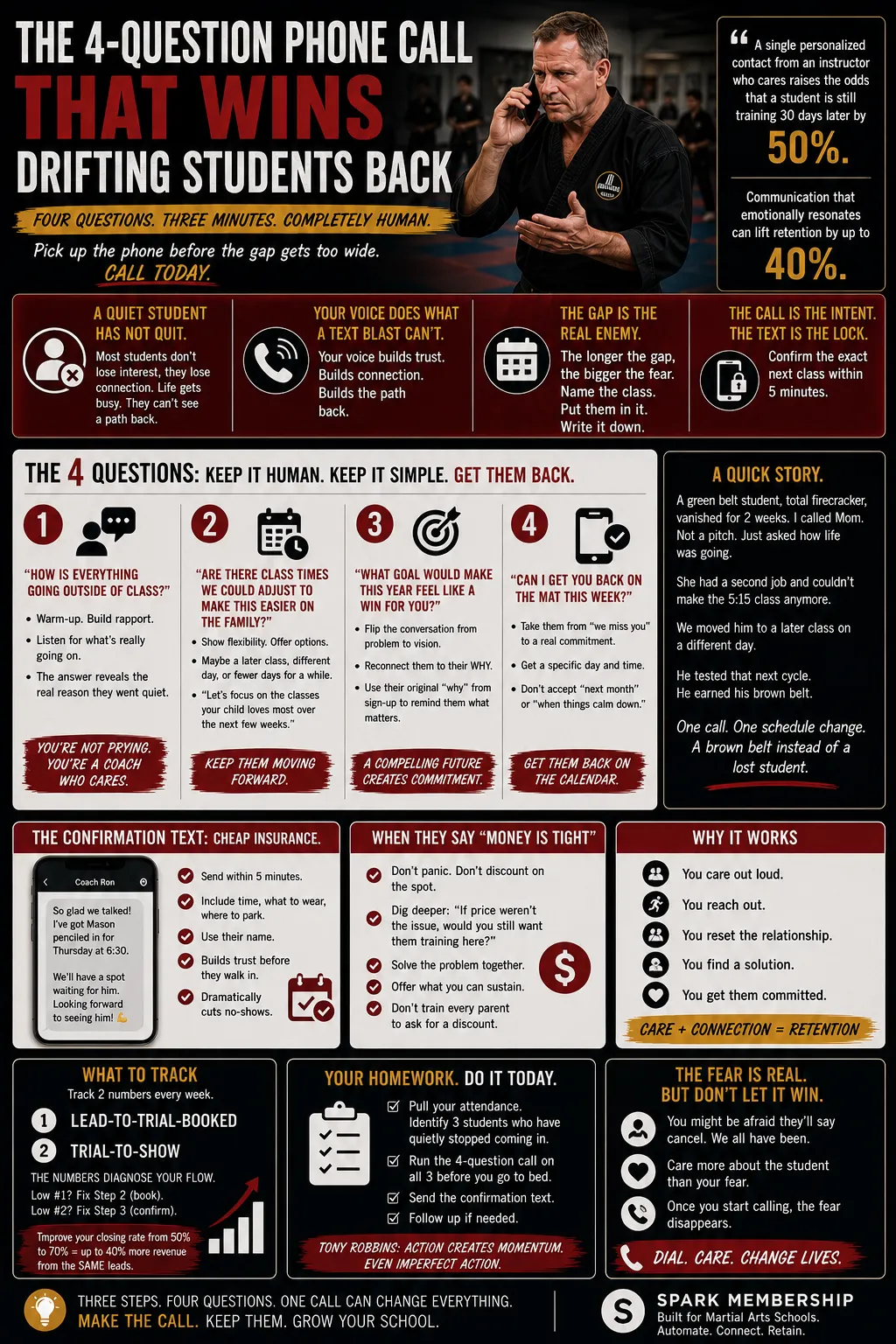
That is where one good phone call does more than any campaign you can run. A single personalized contact from an instructor who cares raises the odds a student is still training 30 days later by about 50 percent.
I walk through that conversation question by question in the 4-question phone call that wins drifting students back. If a student has gone quiet on you, read that next. It is the exact call.
The Real Lesson
Most students who quit were never that far gone. They drifted, nobody reached out, and the drift became a decision by default.
So the real question is not “what do I say when a student wants to quit.” It is “am I paying close enough attention to reach them before they get there?”
Pull your attendance today. Find the three students whose visits have quietly dropped off. Do not wait for them to send the text.
Call them this week.
That call is the whole job.
If you want the deeper philosophy underneath all of this, read the one thing that keeps students training for years.
Now go teach the best classes of your life. Your community needs you, and they need you now more than ever.
Frequently Asked Questions
What should I say when a martial arts student wants to quit?
Do not argue and do not panic. Get curious first. Ask how life is going outside of class, because the answer is almost always the real reason. Then reframe quitting as a normal, beatable dip rather than a final decision, and offer a path back like a schedule change or a smaller program. Lead with care for the student, not concern for the contract.
Why do most martial arts students actually quit?
Most quit from boredom or a dip in motivation, not because they decided martial arts is not for them. Roughly 41 percent of students who quit do so because they lost interest or motivation. That matters because boredom and a motivation dip are fixable, while a true decision to leave is not. Most of the time you are dealing with the fixable kind.
Should I offer a discount when a parent says they want to cancel?
Not as your first move. The moment you discount the second a parent flinches, you signal that you care more about the payment than the child, and you train every parent to ask for a discount. Instead, ask if price were not the issue would they still want their child training here. The answer is almost always yes, and now you are solving the problem together.
What do I say when a parent says money is too tight to continue?
Lead with the family, not the offer. Say something like, we never want money to be the reason a child misses out on something this transformational, let us find a solution that works for your family. If the love and progress are still there, find a way with a short freeze, a payment adjustment, or a smaller program. A student you keep through a hard season becomes a student for life.
What do I say when a kid says they do not feel like coming anymore?
Make it a life-skill conversation, not a martial arts conversation. Quitting when it gets boring or hard does not build success, it builds a habit of giving up. Tell the parent this is their child's moment to learn follow-through, and that all champions hit plateaus, what separates them is they keep going. Said with warmth, not pressure, it lands because it is true.
How do I stop students from quitting before it happens?
Pay attention to attendance. Most students who quit were never that far gone. They drifted, nobody reached out, and the drift became a decision by default. Pull your attendance report, find the students whose visits have quietly dropped off, and call them before they send the cancellation text. Reaching them early is the whole job.