Martial Arts Student Retention: The 4-Question Phone Call That Wins Drifting Students Back
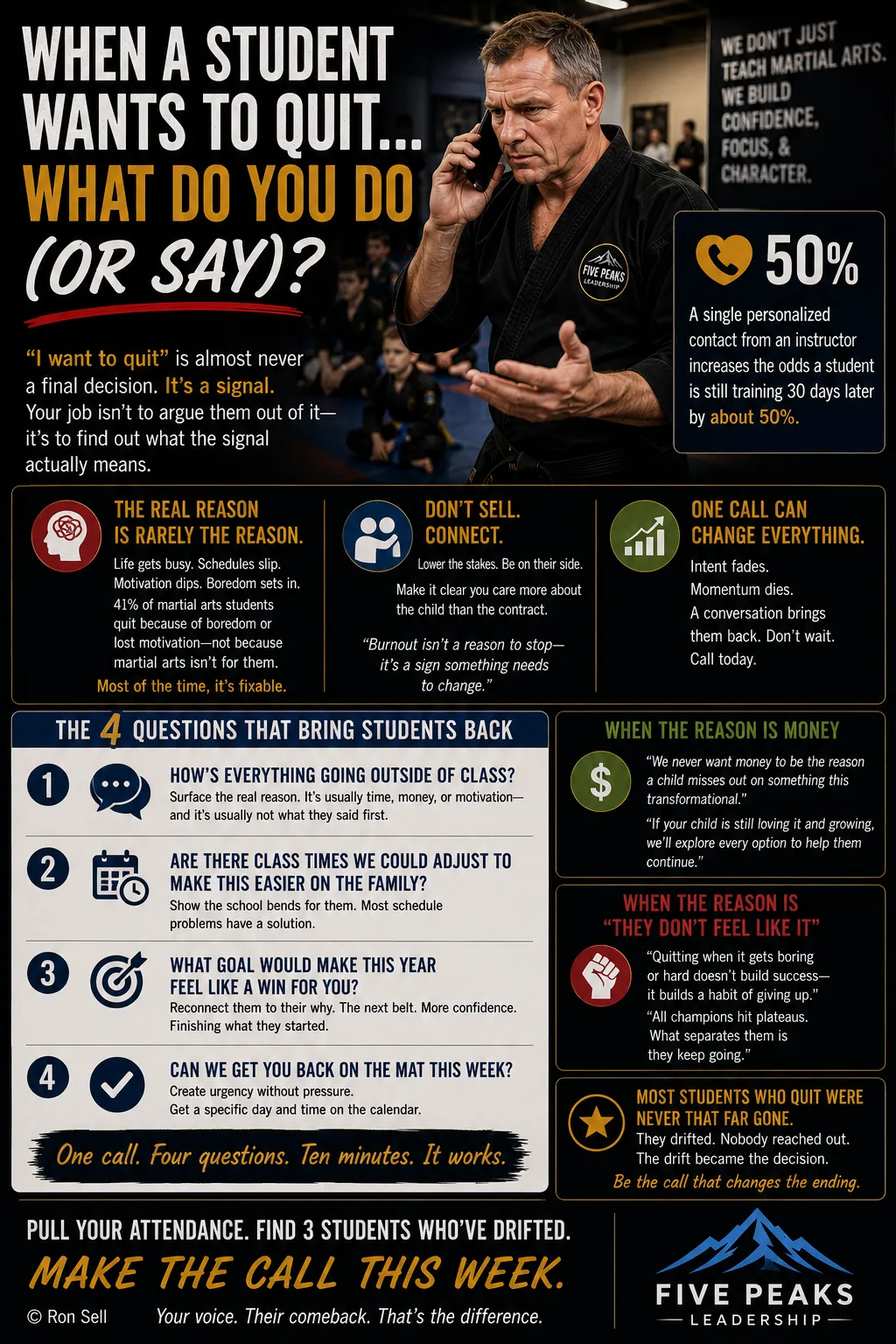
A 3-minute, 4-question phone call is the best martial arts student retention tool you have. Here is exactly what to say to win back students who went quiet.

There is one phone call that has won back more students for my schools, and the schools I coach, than any marketing campaign I have ever run.
Four questions. Three minutes. Completely human.
No script you have to memorize. No slick sales pitch. Just a student, a phone, and an instructor who cares.
If you have got students drifting away right now, the ones who used to be in two or three days a week and you have not seen them in a couple of weeks, this is the call to make. Not Monday. Today.
That is the whole game in martial arts student retention. Pick up the phone before the gap gets too wide.
A Quiet Student Has Not Quit
Most school owners think a student who is silently drifting away has already quit in their mind.
I know you have felt that way. You have not seen someone in a while, and a little voice says, “Maybe I should call.” And then another voice says, “What if they just tell me to cancel their program?”
So you do nothing.
I have been there. I have thought that exact thought. But it is not true.
Missing a few classes almost never means they are gone. A student who goes quiet is not making a decision in that moment. Life got busy. The schedule slipped. Soccer started. Mom went back to work. Motivation dipped for a few weeks.
That is it. It does not mean anything more than that.
Most students do not lose interest. They lose connection. The desire for your program did not die. They just cannot see a path back through whatever life threw at them.
So who builds that path back?
You do. With one phone call.
Your Voice Does What A Text Blast Can’t
A single personalized contact from an instructor who cares raises the odds that a student is still training 30 days later by about 50%. And communication that emotionally resonates, where the person on the other end feels truly seen, can lift retention by up to 40%. I got that from Roland Osborne, who did the big deep-dive study on it.
A text blast does not do that. An email does not do that.
Your voice does.
Let me tell you a quick story.
A couple of years back I had this kid. Green belt. Total firecracker on the floor, the kind of student who is an A-plus kid and in love with the place.
Then nothing. Two weeks gone quiet.
The old me would have waited. “He will be back, he loves this stuff too much.”
Instead, I called Mom on a Tuesday. I did not pitch her. I did not guilt trip her. I did not even ask why he had not been in class.
I just asked her how her life was going.
Turns out she had picked up a second job and could not make the 5:15 class anymore. That was it. That was the whole problem.
So we moved him to a later class on a different day. He tested that next cycle. He earned his brown belt a little after that.
One phone call. One schedule change. A brown belt instead of a lost student.
The Four Questions
I think best in lists, so here is the call, question by question. Say it in your own words. The heart matters more than the script.
Question 1. “How is everything going outside of class?”
Notice we do not go right for the class. We do not say, “Hey, why have you not been in?” We ask about LIFE.
This is the warm-up. This is the rapport. You are asking about the new baby, the job change, an injury they might have, a new sport that ate up their week, the extra homework because school got crazy.
And here is the magic. The answer to that one question is almost always the real reason they went quiet. You will have it in about 30 seconds.
Maybe it is money. Maybe it is the schedule. Maybe they are nervous about sparring. Maybe it is just a really busy season for the family. These are the same reasons students stall every single time.
You are not prying. You are a coach who noticed they were gone and cared enough to ask. That alone resets the whole relationship.
Question 2. “Are there class times we could adjust to make this easier on the family?”
This is the one parents never expect.
You are showing them the school BENDS. We are flexible. We would rather move them to a different time than lose them altogether.
And this is not you being soft. This is a real system. We call it a flex or a modified schedule. Maybe it is a later class. Maybe it is two days a week instead of three for a few weeks while life settles down. Maybe it is just their favorite classes. You keep them moving forward instead of letting them disappear.
Here is a power phrase you can hand the parent: “Let’s focus on the classes your child loves the most over the next few weeks. Bring back the fun, and take the overwhelm off your plate.”
Now, this only works if your timetable actually has the room. If you run a criss-cross schedule with earlier and later times on different days, you have got options. If your schedule is tight, do not promise flexibility you do not have. Offer what your school can actually deliver.
Question 3. “What goal would make this year feel like a win for you?”
This is the goal section, and it is my favorite.
I believe that when someone has a compelling future, they stick with things longer. That is WHY the belt system is so powerful. We have a built-in set of goals to chase. We give people something to look forward to.
That is how all humans work. It is how I work. I have a goal right now to get in the best shape of my life, and just writing it down and chasing it keeps me consistent. Your students are no different.
So you flip the whole conversation. From the problem, money or schedule or busy or other sports, to a vision. You reconnect them to their WHY. Why did they walk in your door in the first place? The confidence. The discipline. The black belt they said they wanted.
And here is where the right system pays off. If you captured their why at sign-up, on a clipboard or a tablet, you are armed. You can say, “I know you really wanted your son to stick with something. Is that still the goal?” Or, “You told me you wanted to feel less stressed. Is that still the goal?”
That pulls their mind off all the chaos and back to the original reason they started training.
Question 4. “Can I get you back on the mat this week?”
That is it. Direct.
You are taking them from a “we miss you” feeling to a real commitment. And often they will say, “I will come in tomorrow.”
But we want a specific date and time. Write it down, because we are going to follow up.
Do not let them off with “not next month” or “when things calm down.” Things never calm down. You know that in your life, and I know it in mine. We have got to get them back on the mat THIS week.
So nudge them. Gently, like a good coach. Because the longer the gap, the lower the odds.
Why The Gap Is The Real Enemy
I fell in love with a sport once. I am not going to name it, because I am still not playing it, and that is kind of the point.
I loved it. Then life happened. Vacations, birthdays, kids, family, running my business. And eventually the gap got so wide I forgot I ever loved it in the first place.
Nobody called me. No friend said, “Hey, we are showing up Tuesday, get out here.” If someone had, I would have remembered how much that sport lit me up.
That is what happens to your students.
Every week away makes the next class feel bigger and scarier in their head. “Everybody is ahead of me now. I have forgotten the combos. I do not remember how to do that self-defense move.”
The wider the gap, the bigger that fear grows. So name the class, put them in it, and write it down.
The Call Is The Intent. The Text Is The Lock.
Here is where most owners blow it. They have a perfect call, they hang up, and they do nothing.
The call is the moment of intent. The text you send afterward is the lock.
Within five minutes of hanging up, send a short text that confirms the exact next class on the calendar. Specific and real.
Here is what it sounds like:
“So glad we talked! I’ve got Mason penciled in for Thursday at 6:30. We’ll have a spot waiting for him. Looking forward to seeing him!”
That is it. Make it real. Make it specific.
Because intent fades. A calendar does not.
This is the same speed-to-contact principle we use with brand new leads in the 3-step lead-to-trial flow. Same idea, different stage of the relationship.
What To Do When They Say “Money Is Tight Right Now”
You are going to hear this one. I have heard it plenty.
Do not panic. And do not discount right there on the spot. That would be silly.
Dig in a little deeper instead. I like to ask, “If price weren’t the issue, would you still want them training here?”
The answer is almost always yes. And once it is yes, now you are solving the problem together instead of losing them over it.
This is something you should be ready for BEFORE you dial. What are you going to do when a parent says her husband lost his job? Maybe it is a short-term schedule adjustment. Maybe it is a temporary plan that gets them through until they are back on their feet.
You are not begging them to stay. You are helping them win.
Now, how far you can bend depends on your market and your margins. A premium school can absorb a short freeze more easily than a budget school running thin. Offer what you can sustainably offer. And know this: if you discount the second someone flinches, you train every parent to ask for a discount.
You Already Know How To Do This
The schools that retain at the top of our industry are not magical. They do not have a secret.
They are the ones who pick up the phone when a student goes quiet. That is the whole secret.
You are caring out loud. You are reaching out, making the connection, resetting the relationship, finding a solution, and getting them committed to a specific day and time.
And I know you can do this. Because you already care. That is why you are reading this.
Now let me be honest about the part nobody talks about. The fear.
I used to be afraid to call a student who had not been in for a month. I was afraid they would tell me how awful we were and that is why they quit. I was afraid they would say they wanted to cancel.
So sometimes I did not pick up the phone.
The way I got over it was simple. I care more about that student than I care about my fear. I KNOW that if I get them back on the mat, I can impact their life in a powerful way.
So I got over it and I dialed.
And you know what is crazy? Once I started making the calls, the fear disappeared. The worst-case scenario almost never showed up. I just wished I had started sooner.
If you want the deeper philosophy behind all of this, read the one thing that keeps students training for years. It is the foundation under this entire call.
Your Homework. Do It Today.
Pull your attendance. If you are on Spark, it is a quick attendance report.
Pick three students who have quietly stopped coming in. Then run this call on all three before you go to bed tonight.
Tony Robbins says to take action right away, because action creates momentum. Even imperfect action. You might get on the phone and totally fumble the words. That is okay.
You know what comes through? Your heart. The exact words matter way less than the fact that a caring instructor picked up the phone.
Leave a message. Call back. They might not respond for a few days. But do three today. Maybe three more tomorrow.
It is not a big ask. Just three.
So here is my question for you: what is the real reason your students go quiet in YOUR market? Drop it in the comments. Rising tide lifts all boats.
Now go teach the best classes of your life. Your community needs you, and they need you now more than ever.
Frequently Asked Questions
How do I win back martial arts students who stopped coming?
Call them. One personal phone call from an instructor who cares does more for retention than any marketing campaign. Ask how life is going outside of class, offer to adjust their schedule, reconnect them to their goal, and get them committed to a specific class this week. Then send a follow-up text within 5 minutes confirming the exact class.
What should I say when I call a martial arts student who has gone quiet?
Use four questions. How is everything going outside of class? Are there class times we could adjust to make this easier on the family? What goal would make this year feel like a win for you? Can I get you back on the mat this week? It takes about three minutes and it is completely human, no script to memorize.
Does a student who misses class for a few weeks mean they quit?
Almost never. A student who goes quiet is usually not making a decision in that moment. Life got busy, the schedule slipped, a new sport started, or motivation dipped. They lose connection, not interest. Your job is to build the path back with a phone call.
How do I handle a parent who says money is tight for martial arts?
Do not panic and do not discount on the spot. Ask if price were not the issue, would they still want their child training here. The answer is almost always yes. Then solve it together with a short-term schedule adjustment or a plan that fits what your school can sustainably offer until they are back on their feet.
Why should I send a text after calling a martial arts student?
The call is the moment of intent. The text is the lock. Within five minutes of hanging up, send a short message confirming the exact next class, specific and real. Something like, So glad we talked, I have Mason penciled in for Thursday at 6:30. Intent fades, but a calendar does not.
How many students should I call to improve martial arts retention?
Start with three today. Pull your attendance report, pick three students who have quietly stopped coming, and run the four-question call on all three before the day ends. Imperfect action creates momentum, and your genuine care comes through even if the words are not perfect.