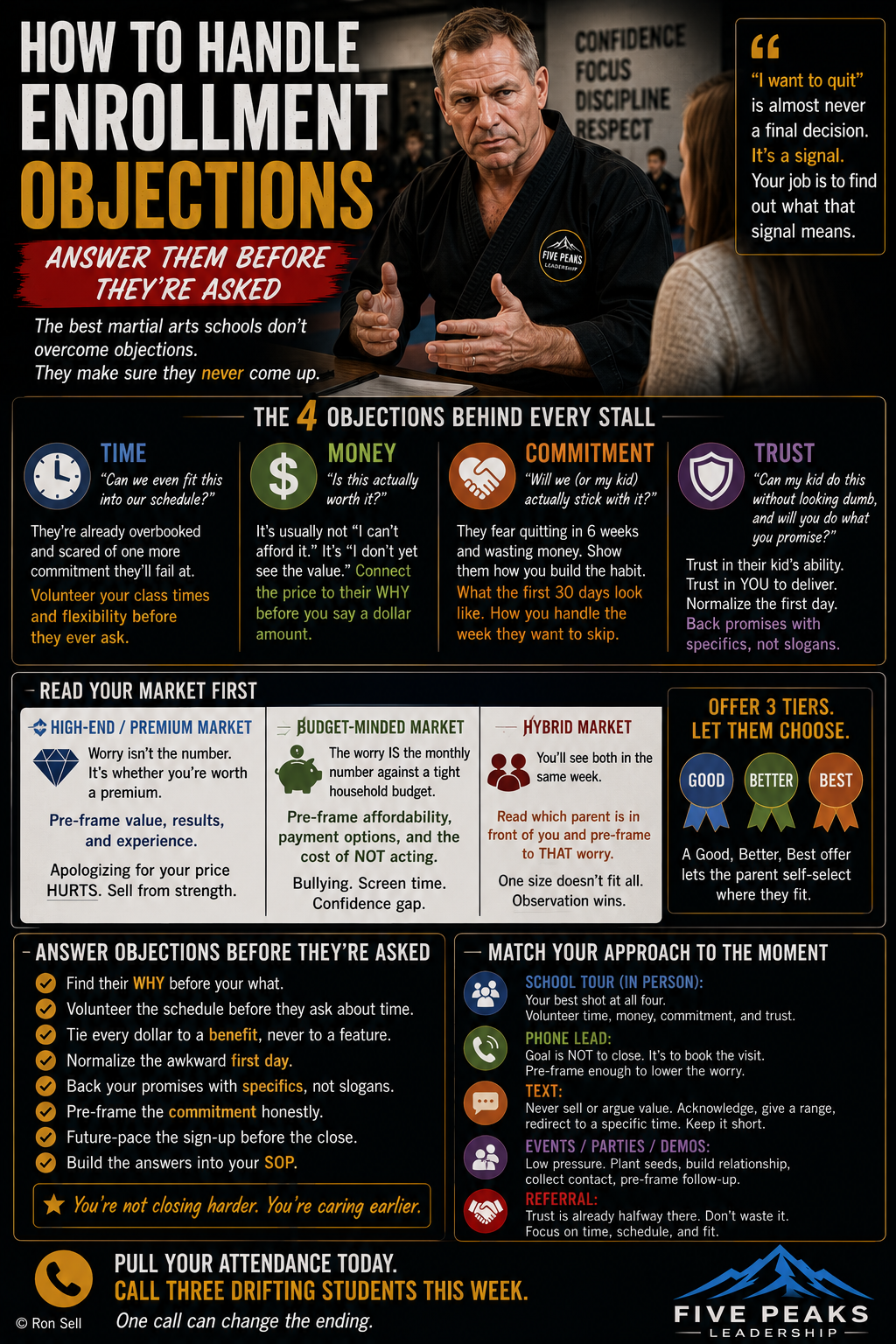
How to Handle Enrollment Objections in Martial Arts: Answer Them Before They're Asked
Learn how to handle the four most common martial arts enrollment objections (time, money, commitment, trust) by answering them before a parent ever asks.
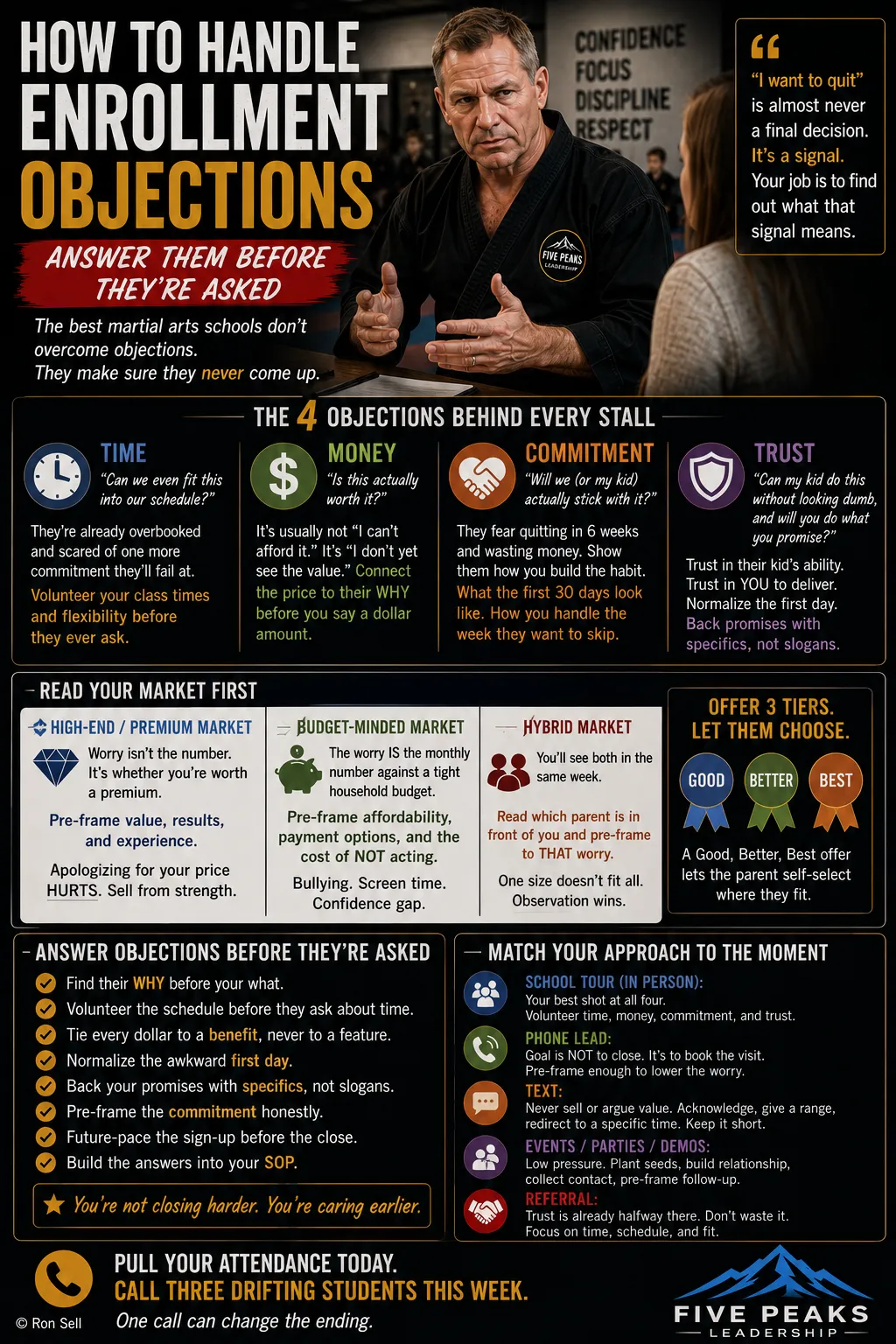
The best martial arts schools don’t overcome objections. They make sure they never come up.
That’s an important distinction from what most school owners and success managers do.
Most school owners think enrollment is won at the end of the first lesson, with the perfect comeback for “I need to think about it.” It’s not. The enrollment is won or lost long before you ever ask a parent to sign anything.
If you are busy handling enrollment objections in your martial arts school, you are already behind. The real goal is to answer every worry BEFORE the parent ever opens their mouth.
You’re Trying to Win an Argument You Could Have Avoided
Here’s what most owners believe: “I need better closing lines. I need a comeback for every objection.”
Wrong problem.
An objection at the table is not a closing problem. It’s a worry you let sit there the entire enrollment conversation, until it finally came out as a “no.”
The parent walked in with a question. You never answered it. So it grew.
A lot of this can be handled way ahead of time. If you do it right, you rarely ever actually hear an objection. You volunteer the information before they ask, eliminating the objection later.
So stop collecting clever rebuttals. Start building a conversation that defuses the worry before the parent ever says it out loud.
And here’s the key: all of this should be handled during your school tour, before their first lesson.
The 4 Objections Behind Every Stall
I think best in lists, so here is a list.
Every stall, no matter how it sounds, traces back to one of four worries. Time. Money. Commitment. Trust.
That’s it. Learn the four and you stop reacting to the words. You start answering the worry underneath them.
TIME. “Can we even fit this into our schedule?”
Underneath, they’re already overbooked and scared of one more commitment they’ll fail at. So volunteer it. Bring up your class times and your flexibility before they ever ask. “A lot of our families come in worried about fitting this in, so let me show you how the schedule works for busy households like yours.” You named it for them. The worry deflates.
MONEY. “Is this actually worth it?”
This one is almost never “I can’t afford it.” It’s “I don’t yet see the value at this price.” Money is rarely a number problem. It’s a value-clarity problem. So connect the price to their WHY before you ever say a dollar amount. (More on how this changes market to market in a second.)
COMMITMENT. “Will we (or my kid) actually stick with it?”
Underneath is the fear of being the family that quits in six weeks and wastes the money. They are protecting themselves from their own track record. So tell them up front how you help families build the habit. What the first 30 days look like. How you handle the week the kid wants to skip.
TRUST. “Can my kid do this without looking dumb, and will you do what you promise?”
This is the big one, and it has two heads. Trust in their kid’s ability to actually do this. And trust in YOU to deliver what you said you would. Pre-frame both. Normalize that every white belt felt clumsy on day one. And back your promises with specifics, not slogans.
Read Your Market First
The money objection does not mean the same thing in every market. So read your market before you decide how to handle it.
If you’re in a high-end, premium market: the worry usually isn’t the number. It’s whether you’re worth a premium. Pre-frame the value, the results, the experience. Apologizing for your price here actually HURTS you. Sell from strength. Don’t underprice. It only diminishes the value they think they’re getting.
If you’re in a budget-minded, value-conscious market: the worry really is the monthly number against a tight household budget. So pre-frame affordability, your payment options, and the cost of NOT acting. The bullying. The screen time. The confidence gap that keeps growing.
If you’re in a hybrid market: you’ll see both walk through your door in the same week. The skill is reading which parent is sitting in front of you, then pre-framing to THAT worry, not your default one.
One thing that works across all of them is a simple three-tier offer. A Good, Better, Best. It lets the PARENT self-select where they sit, instead of you guessing.
Here’s how I do it on the school tour. I call it the price drop.
When I walk a family through our programs, during the School Tour, I just answer the question that’s already sitting in their head:
“We have three different levels of membership at our school. Our Basic Program, this is the program everyone starts at, and it’s perfect for you. We also have our Black Belt Training program and our Leadership Program. You wouldn’t be ready for those two yet. When you are, we’ll talk more about that with you, sound good? The Basic Program is only $250 per month.”
That’s the price drop. The whole goal is to answer the question that’s in their mind, so they can close the open loop.
Because once they know the number, everything else you show them for the rest of that appointment gets measured against it. Every drill, every win, every story. They’re quietly asking themselves, “Is the value here bigger than $250?” And when you’ve done your job, the answer is YES.
If they push for more on price before you’re ready, don’t get pulled off your tour. Just say, “We’ll go over all the options soon, all your questions will be answered.” Then keep moving.
Match the Approach to the Moment
The same objection lands differently depending on WHERE the conversation is happening. So match your approach to the moment.
The school tour (one on one, in person). This is your best shot at all four. You have the time, the body language, the room. Build the whole walkthrough to volunteer time, money, commitment, and trust before you ever ask them to enroll.
The phone lead. Less time, higher stakes. The goal of the call is NOT to close. It’s to book the visit. Pre-frame just enough to lower the worry and get them in the door. Give a price range if they ask, then redirect right back to scheduling.
Text. Never sell or argue value over text. Acknowledge, give a range, redirect to a specific time. Walls of text kill it. Keep it short. Get them booked.
Community event, birthday party, school demo. Low pressure, relationship first. Nobody’s objecting yet, because nobody’s deciding yet. Plant the seeds. Collect the contact. Pre-frame the follow-up.
Referral. The trust objection is already half-solved, because someone they believe in vouched for you. Don’t waste that gift. Lead the conversation somewhere else. Time, schedule, fit.
This is also where it pays to treat every prospect like a future student, and to have a simple system to get them booked for a trial. The pre-framing only works if they actually show up.
Let Me Tell You a Quick Story
I was recently reading a Facebook post from a school owner who asked, “What objections do parents have when you’re trying to enroll them?”
It took me right back.
Because I used to get SO much pushback during enrollment. The stalls, the “let me talk to my spouse,” the “we’ll think about it.” And I lost a lot of good families during that conversation. Families I KNOW we could have helped.
So I went to work on it. I kept refining the school tour, kept volunteering the answers earlier and earlier, until one day I realized something.
We weren’t getting objections anymore.
It came down to just two things. Did they actually have the money or not. And did we run a smooth, caring enrollment process.
That’s it. Everything else, every worry about time and commitment and whether their kid would look silly, we had already answered before we ever asked them to enroll.
How to Answer Objections Before They’re Asked
Here’s what we actually changed.
-
Find their WHY before you talk about your what. Nobody enrolls to learn a roundhouse kick. They enroll because their kid is getting bullied, or because they want their confidence back. Get the WHY first and every objection shrinks, because now the price is being measured against something that matters.
-
Volunteer the schedule before they ask about time. Don’t wait for the time objection. Bring it up first. “A lot of busy families worry about fitting this in.” Naming it for them tells them you GET it, and it lifts the worry right off their plate.
-
Tie every dollar to a benefit, never to a feature. The money objection dies when the price is attached to their kid’s confidence, not to “two classes a week and a uniform.” Sell the transformation first. Then the price has something to stand on.
-
Normalize the awkward first day. The fear that their kid will look dumb is real, and it almost never gets said out loud. So say it for them. “Every black belt in this room felt clumsy on day one.” You just removed a fear they were too embarrassed to mention.
-
Back your promises with specifics, not slogans. “We build confidence” is a slogan. “Here’s exactly what the first 30 days look like, and here’s how we handle the week he wants to quit” is a promise they can trust. Specifics earn trust. Vagueness invites the objection.
-
Pre-frame the commitment honestly. Don’t hide that this takes consistency. Owning it builds more trust than pretending it’s easy. “There’s going to be a week he doesn’t want to come. Here’s what we do when that happens.” Now you’re a partner, not a salesman.
-
Future-pace the sign-up before the close. “When you come in, if you love it, we’ll get you started, fair enough?” Said early, it takes the surprise and the pressure right out of the close.
-
Build the answers into your SOP so it’s not personality-dependent. We designed step by step methods to make this easy, and we train owners and staff to run the process without ever feeling like a salesman. Your front desk should pre-frame the exact same way you do. Then role-play it weekly until it’s second nature.
You’ve Got This
You already give a damn about these families. You’re not trying to trick anyone into anything.
You have a program that genuinely changes kids’ lives. Pre-framing objections isn’t manipulation. It’s leadership. It’s removing the fear that’s standing between a family and the help they walked in looking for.
When you answer the worry before they ever have to ask, you’re not closing harder.
You’re caring earlier.
Let’s Take Action Today
Do today: Take your last lost enrollment. Write down which of the four it really was. Time, money, commitment, or trust. Then write the ONE sentence you could have said earlier in the school tour to defuse it. That sentence goes in your script.
Your turn: What’s the objection you hear most at your school? And be honest, is it really about that? Or is it one of the other three wearing a disguise?
Frequently Asked Questions
What are the most common martial arts enrollment objections?
Almost every stall traces back to one of four worries: time (can we fit this into our schedule?), money (is this actually worth it?), commitment (will we stick with it?), and trust (can my kid do this without feeling dumb, and will you keep your promises?). Once you know the four, you stop reacting to the words and start answering the worry underneath them.
How do I overcome the price objection in martial arts enrollment?
Money is rarely a number problem. It is a value-clarity problem. Find the parent's real why before you ever say a dollar amount, then tie the price to that outcome, not to features like uniforms or class counts. In a premium market, sell from strength and never apologize for your price. In a value-minded market, lead with payment options and the cost of doing nothing.
How do I stop hearing objections during enrollment in the first place?
Volunteer the information before the parent ever asks. If you bring up the schedule, the cost, the commitment, and the first-day nerves yourself, early in the school tour, the worry deflates before it can come out as a no. Handled well, you rarely hear an objection at all, because you answered it ahead of time.
Should I handle martial arts objections on the phone or wait for the visit?
The goal of the phone call is not to win the objection, it is to book the visit. Pre-frame just enough to lower the worry and get them in the door. Give a price range if they ask, then redirect to scheduling. Save the full pre-framing for the in-person school tour, where you have the time and the room to answer all four worries.
How do I build trust with a parent during enrollment?
Trust has two sides: trust in their own kid's ability, and trust in you to deliver. Normalize the awkward first day so the parent stops worrying their child will look clumsy. Then back your promises with specifics, not slogans. Saying exactly what the first 30 days look like earns far more trust than promising you build confidence.
How do I train my front desk staff to handle enrollment objections?
Make it an SOP, not a personality trait. Write down how you pre-frame each of the four objections, then role-play it with your team for 15 to 30 minutes every week. When the answers are built into your process, every caller gets the same calm, prepared experience no matter who picks up the phone.