How to create systems your team can follow
If a simple checklist can save lives on an airplane, a simple checklist will also save students from quitting.
We all know that the best companies run on systems.
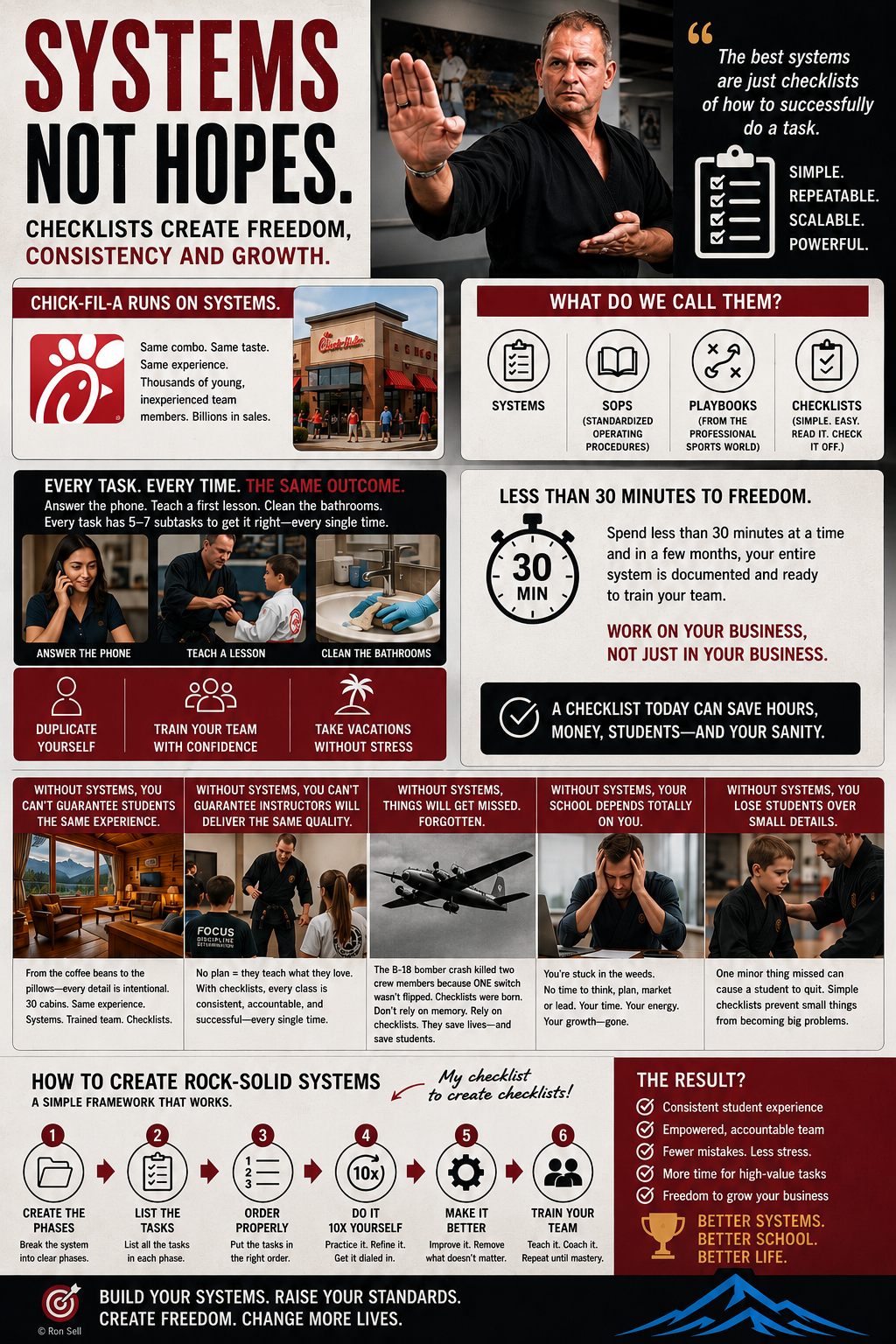
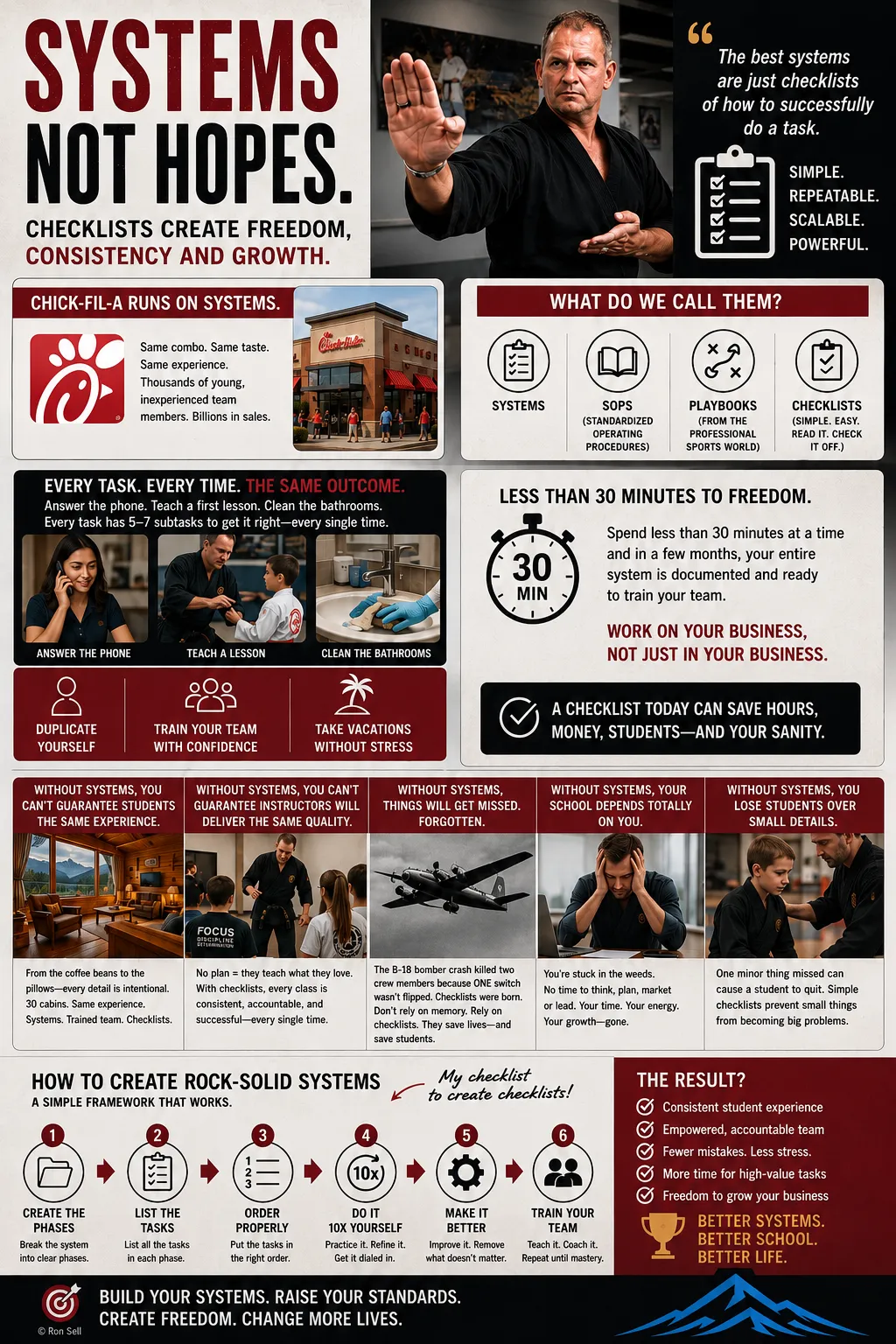
Whether you like Chick-fil-A’s food or not, they run on systems. The same Combo #1 in Tampa, will be the same Combo #1 where you live. And it will taste the same. Giving us the same consistent experience every single time.
And most of their employees are young and inexperienced, and probably have less than a few months on the job, and still run one of the largest food franchises in the world. Some of them, this was their first job, yet they can perform their tasks the same way here in Tampa as they do in your town.
I am calling it “systems”, but some people prefer SOPs (Standardized Operating Procedures), Playbooks (comes from the professional sports world) or even just “checklists.”
When it all boils down to it, I like the term “checklists.” Checklists sound simple, easy, just read and check it off.
The best systems are just checklists of how to successfully do a task.
Tasks like how you answer your phone, or teach a new student their first lesson, or how we clean the bathrooms.
Each of these tasks should have their own checklist of the 5 to 7 subtasks that need to be done to get the same outcome every single time.
This is how you duplicate yourself. This is how you train someone else to take over projects in your martial arts school. I know you would prefer to do higher level tasks in your school, or take a vacation without stressing over how things are running while you are not there. That is why checklists are so important.
It is an easy process, and you could probably spend less than thirty minutes at a time, and in a few months, can have your entire system documented. Ready to train your team on.
Less than 30 minutes to freedom.
I am sure you have heard the saying “work ON your business, and not just IN your business.”
This is one of those tasks that qualify as working ON your business, and pays back profits for the next 30 years.
If you clean the bathroom, because only you do the best job at it, you will always be stuck cleaning that bathroom. If you spend less than 30 minutes writing down the step-by-step process of what a world-class looking bathroom looks like, you now have a training tool, and a built in way to monitor if that has been done to your standards. You have a tool that allows your team members to understand how to do something, and more importantly what a world-class job looks like. Now that staff member can take OWNERSHIP of that task.
When you create your systems, it helps you not only create a training tool for your team, but it allows you to create the standard of how you want every area of your business to run. It helps you create standards. You get to set the standard.
You want high standards, that is probably why you have not let go of certain areas of your business because you know only you can do it to your standard. And this hold a lot of school owners from seeing the growth they want.
Setting the standard, creating the system with checklists, then training another team member to use the checklist as their guide will allow you to keep the high standards, and focus on higher level tasks.
Obviously, you can not just hand a checklist to a team member and walk away and expect them to meet your standard. That is why we train them over a few weeks or months, explaining the checklist, showing them how you do it, pointing out the areas that are most important, allowing them to give it a try, and providing feedback along the way. We do this until they have mastered it the way we expect.
Without systems you can not guarantee students will have the same experience every single time.
I recently took my wife away to Tennessee for a romantic get-a-way for couples only. Log cabins on the mountainside, as we stepped into the cabin, overlooking a beautiful valley, everything was intentional. From the coffee beans, to the record player playing at the perfect volume, to the way the pillows were in the perfect spot.
How were they able to setup 30 cabins in the same manner, in just a few hours? They had systems in place, a well trained team, and checklists.
Without systems you can not guarantee instructors will do the exact same quality as you
Once, a student walked in and asked “Is Instructor John teaching today?” “Yes!”, they turned around and walked out, to come back tomorrow. After digging in, I found out Instructor John only liked to spar. Every class he taught what he loved. That is the default for any team member, they taught only the things they loved, it is the go to.
Instructor John was a great teacher, students loved him. But he did not have a plan to follow. That was on me.
I started creating a checklist of what a perfect class looked like, trained my team, made them check it off every single class and turn it in to me at the end of every night.
Classes became consistent. All instructors followed the plan. All instructors were held accountable. They now knew what a successful class looked like.
This also helped me go on more vacations where I wasn’t on pins and needles the entire time wondering if classes were the same standard I expected. My wife and kids noticed I was more present as well.
Without systems, things will get missed. Forgotten.
The most powerful story I have ever heard was about the B-17 Bomber. It was the largest airplane that was ever built. At a test flight, they chose the best pilots and the best crew on the planet. The plane took off, people were amazed, until the plane got 300 feet off the ground. The nose went up, the engines stalled, the plane crashed into a fiery ball of flames. Two crew members died. It almost bankrupted Boeing.
The engineers studied what went wrong. It ended up ONE switch wasn’t flipped. Locking the elevator control.
The lesson was that the airplane was not “too complex to fly,” but too complex to depend on memory alone. In response, Boeing and Air Corps personnel began using formal written checklists for phases such as taxi, takeoff, flight, and landing.
One nuance matters: historians note that checklists were not invented from scratch in 1935; rather, the Model 299 crash helped institutionalize the modern cockpit checklist in aviation.
I know that running a martial arts school is not as complex as flying the world’s largest plane, but we also have our own complexities. We have a LOT going on, a ton of moving parts. And often we lose a student over one minor detail we missed.
If a simple checklist can save lives on an airplane, a simple checklist will also save students from quitting.
Without systems your martial arts schools depends totally on you, the owner.
You are stuck with it. Not only stuck with it, but you can not grow into a higher value leader. You will be forever tied to every task in your school. As you grow, tasks increase. Your time ends up spent on lower value tasks, and not on running a world-class team. No time to think, plan, market or sell. Not just your time, but your energy.
How to create rock-solid systems
Systems are not hard, they just take a little time, and if you commit to spending as little as 30 minutes at a time, you can create world-class systems for your martial arts school. I could give you my systems, but they are not based around your personal standards. What is important to my business may not be as important to yours. It is important that you create your standards and your own personalized systems.
But I can give you the same framework I use when I create my systems.
Basically, my checklist to create checklists!
See, I practice what I teach!
- Create Phases of the system you want to create
- In each phase, create the tasks
- Order the tasks in the proper order
- Do it 10x yourself
- Make changes, make it better, remove anything that doesn’t matter
- Train a staff member (this may take 10x for them too)
Frequently Asked Questions
How do I create systems for my martial arts school?
Build simple checklists for each task, like how you answer the phone, teach a new student their first lesson, or clean the bathrooms. Each task should have its own checklist of the 5 to 7 subtasks needed to get the same outcome every single time. Spend as little as 30 minutes at a time, and in a few months you can have your entire system documented and ready to train your team on.
What is the best way to make my martial arts classes consistent across instructors?
Without a system, instructors default to teaching only the things they love, so the quality changes depending on who is on the mat. Create a checklist of what a perfect class looks like, train your team on it, and have them check it off and turn it in at the end of every night. That is how all instructors follow the same plan, stay accountable, and know what a successful class actually looks like.
Why are checklists important for running a martial arts school?
A martial arts school has a ton of moving parts, and often you lose a student over one minor detail you missed. Checklists keep things from getting forgotten and set the standard for how every area of your business should run. If a simple checklist can save lives on an airplane, a simple checklist will also save students from quitting.
How do I train a team member to take over tasks in my martial arts school?
You can not just hand someone a checklist, walk away, and expect them to meet your standard. Train them over a few weeks or months: explain the checklist, show them how you do it, point out the areas that matter most, let them try, and give feedback along the way. Keep going until they have mastered it the way you expect.
What framework should I follow to build systems for my martial arts business?
Use the same six steps I use, basically a checklist to create checklists. Create the phases of the system, list the tasks in each phase, put them in the proper order, do it 10 times yourself, then make changes and remove anything that does not matter. Finally, train a staff member, and know that step may take 10 times for them too.
How can systems help me take a vacation from my martial arts school?
When everything depends on you, you stay forever tied to every task and can never step away without stress. Once I built a checklist for what a perfect class looked like and trained my team to follow it, I could go on more vacations without being on pins and needles wondering if classes met my standard. My wife and kids even noticed I was more present.